Compound-replay source: e3ec6d231cc7e5c769685761a4739c8fcffc30ff;
same-input baseline: 84770198dd9e43ddd4aa936d2f5bf9c3deabe550. Native
measurements cover literal phased replay. SQL materializes all current
fields, including local coding-block SO. HGVS generation is disabled in
these recorded output contracts; the measurements do not time
whole-haplotype SO/HGVS. Native and decoded SQL consume standalone ALT
events and decoded calls. The additional source-record SQL lane measures
literal GT parsing and replay; standalone native raw-record execution
and conditional source omissions are not timed. All runs use one thread
pinned to CPU 2 on an Intel Core i5-13500, DuckDB 1.5.3, and a
source-bound clean extension build. The native bridge uses the same
kernel sources compiled with -O3 -DNDEBUG; receipts retain
compiler/version, binary and fixture hashes, worker jobs, GNU-time logs
and complete result fingerprints.
Workload and verification
The
registry
stages two committed, checksum-verified fixtures without network access:
a 180-base CDS and four ALT events. Two substitutions share a codon; an
insertion/deletion pair displaces and restores the frame. Four diploid
sample templates repeat across the cohort, producing exactly three
occupied paths per transcript. Strict phase uses PS=10. Transcript
groups share genomic intervals, with non-overlapping groups 1,000 bases
apart; overlap is the number of simultaneously active transcripts.
This deliberately favourable prefix-sharing workload is not a real population, a long-transcript benchmark, a reader benchmark, or evidence for arbitrary phase and structural configurations. Native input is a factorized, already-ordered feed; SQL input is its complete event/candidate/sample relation stored in hash order. Both retain every source identity and called carrier. The fixture contains only canonical DNA. It exercises shared translation and materialization paths, not the cost of N-rich annotation or consensus resolution.
Before timing, native validation checks every transcript, complete
CDS/protein against independently rebuilt/Biostrings-translated
sequences, contributors and sample/lane/PS/ploidy membership. SQL
validation compares the full carrier multiset with decoded input, checks
sequences and edit provenance, and rejects an injected duplicate. Native
validation also rejects a corrupted expected sequence. Every measured
decoded pass must retain all common native/SQL denominators and SQL’s
full, canonicalized nested-row fingerprint; failed runs are not
promoted. Full fingerprints must also agree across revisions sharing an
output contract. Local coding-block and literal-replay projections
provide separate comparisons with their recorded output contracts; full
current output is always checked. Contracts ending in
_nominal_length_diff include the exact signed sum of source
replacement-length changes. The verifier calculates that sum from
fixture alleles, independently of replayed CDS and block lengths, and
rejects a +3 corruption that preserves frame category. Historical
contracts do not certify this numeric field.
hgvs_so_* fingerprints retain every local-SO/HGVS-schema field and
exclude only nominal_length_diff. local_so_* additionally excludes
hgvsp and hgvsp_status; replay_* also projects each block to its
literal replay fields. non_hgvs_* retains nominal length for the
current HGVS-on/off comparison. The recorded contract determines which
fields were measured; historical full fingerprints are used only for
projections identical to their recorded schema.
Recorded replay input and output denominators
| transcripts | samples | overlap | input_records | projected_events | input_calls | output_leaves | output_carriers | prefixes_created | translated_bases |
|---|---|---|---|---|---|---|---|---|---|
| 1024 | 4 | 1 | 4096 | 4096 | 16384 | 3072 | 7168 | 6144 | 552960 |
| 1024 | 64 | 1 | 4096 | 4096 | 262144 | 3072 | 114688 | 6144 | 552960 |
| 1024 | 64 | 16 | 256 | 4096 | 262144 | 3072 | 114688 | 6144 | 552960 |
| 1024 | 64 | 64 | 64 | 4096 | 262144 | 3072 | 114688 | 6144 | 552960 |
| 1024 | 256 | 1 | 4096 | 4096 | 1048576 | 3072 | 458752 | 6144 | 552960 |
| 10240 | 64 | 16 | 2560 | 40960 | 2621440 | 30720 | 1146880 | 61440 | 5529600 |
input_records counts distinct source ALT events, not candidate/sample
rows. projected_events counts event/transcript pairs.
output_carriers counts memberships of sample/lane keys in completed
leaves; output_leaves counts unique occupied prefixes, not unique
peptide strings. Prefix creation and active pool peaks below are
observed in the native stream, not inferred SQL counters.
Timing and process memory
The figure reports medians and observed min–max ranges. Native replay, decoded SQL and source-record SQL use separate panels because their timed work differs; their times are not speedup comparisons. Input and carrier contracts also differ between the two SQL modes.
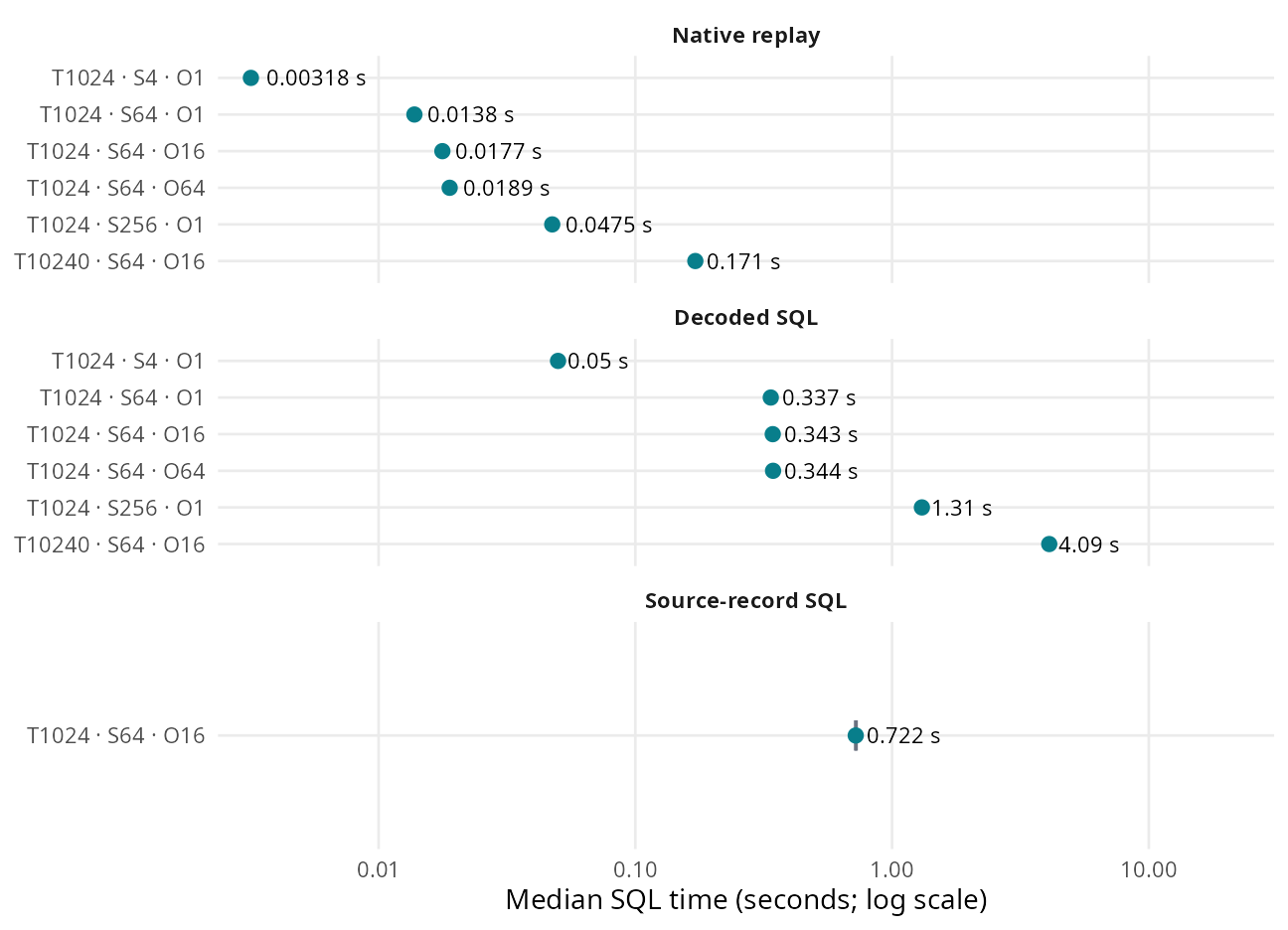
Pass-level timing and process-memory observations
| transcripts | samples | overlap | mode | min_s | median_s | max_s | max_process_rss_mib |
|---|---|---|---|---|---|---|---|
| 1024 | 4 | 1 | native | 0.003 | 0.003 | 0.003 | 73.852 |
| 1024 | 4 | 1 | sql | 0.049 | 0.050 | 0.052 | 216.992 |
| 1024 | 64 | 1 | native | 0.014 | 0.014 | 0.014 | 73.852 |
| 1024 | 64 | 1 | sql | 0.336 | 0.337 | 0.341 | 377.656 |
| 1024 | 64 | 16 | native | 0.018 | 0.018 | 0.018 | 73.855 |
| 1024 | 64 | 16 | sql | 0.340 | 0.343 | 0.344 | 379.527 |
| 1024 | 64 | 16 | sql_records | 0.720 | 0.722 | 0.726 | 611.914 |
| 1024 | 64 | 64 | native | 0.018 | 0.019 | 0.019 | 73.695 |
| 1024 | 64 | 64 | sql | 0.343 | 0.344 | 0.346 | 378.086 |
| 1024 | 256 | 1 | native | 0.046 | 0.047 | 0.048 | 73.855 |
| 1024 | 256 | 1 | sql | 1.303 | 1.307 | 1.307 | 958.125 |
| 10240 | 64 | 16 | native | 0.169 | 0.171 | 0.173 | 73.852 |
| 10240 | 64 | 16 | sql | 4.066 | 4.095 | 4.127 | 2139.703 |
Both compared revisions return each block’s local SO mask, coding status and position relative to the first stop. A shared coding context evaluates physical blocks on completed replay. Full-output fingerprints and input/output denominators match across the compared configurations. The native count sink omits local SO evaluation. HGVS-enabled performance requires a separate workload.
Matched SQL timing observations by source revision
| transcripts | samples | overlap | median_s_before | median_s_after | median_change_percent | max_process_rss_mib_before | max_process_rss_mib_after |
|---|---|---|---|---|---|---|---|
| 1024 | 4 | 1 | 0.050 | 0.050 | 0.000 | 216.531 | 216.992 |
| 1024 | 64 | 1 | 0.336 | 0.337 | 0.298 | 376.359 | 377.656 |
| 1024 | 64 | 16 | 0.341 | 0.343 | 0.587 | 378.410 | 379.527 |
| 1024 | 64 | 64 | 0.344 | 0.344 | 0.000 | 377.574 | 378.086 |
| 1024 | 256 | 1 | 1.295 | 1.307 | 0.927 | 958.684 | 958.125 |
| 10240 | 64 | 16 | 4.093 | 4.095 | 0.049 | 2138.895 | 2139.703 |
Each recorded pass uses a fresh process and a full warm-up. Native timing starts after workspace initialization and includes ordered-feed construction, GT routing, projection, replay/translation, block construction and a count/length sink. It does not include alignment, DuckDB, or nested output materialization.
SQL timing covers
CREATE OR REPLACE TABLE ... AS SELECT * FROM duckvep_haplotypes(...):
preparation, phase-domain discovery, mandatory sort, workspace
initialization, replay, both sequence alignments, local coding-block SO
and all nested output columns. Input/model staging is outside
timing. The warm-up output table is replaced by the measured table. JSON
sizing and fingerprint aggregation occur afterward, not in the timer; no
file-output throughput is claimed.
GNU /usr/bin/time -v measures whole-process maximum RSS, including the
R host, model/input tables, warm-up, measured materialization and
post-run aggregates. The heavier SQL correctness audit runs separately
and is excluded from recorded RSS. RSS is not an isolated operator
allocation measurement. These two execution scopes are intentionally
different: their times are not a speedup comparison. Post-run
fingerprint aggregates depend on the output schema, so a schema change
also prevents interpreting process RSS as an identical-work memory
comparison.
Complete SQL output-size measurements
| transcripts | samples | overlap | output_leaves | cds_bytes | protein_bytes | json_bytes |
|---|---|---|---|---|---|---|
| 1024 | 4 | 1 | 3072 | 552960 | 184320 | 5142266 |
| 1024 | 64 | 1 | 3072 | 552960 | 184320 | 12185338 |
| 1024 | 64 | 16 | 3072 | 552960 | 184320 | 12157566 |
| 1024 | 64 | 64 | 3072 | 552960 | 184320 | 12141566 |
| 1024 | 256 | 1 | 3072 | 552960 | 184320 | 35028730 |
| 10240 | 64 | 16 | 30720 | 5529600 | 1843200 | 121850254 |
CDS/protein bytes count the sequence views returned once per occupied leaf. JSON bytes are the measured UTF-8 size of complete canonicalized SQL rows, including carriers, contributors, blocks and differences; they are not bytes written to disk.
Sparse native state
The points show measured native workspace capacity across the recorded transcript/sample configurations. Labels give the workspace size; immutable model storage is reported separately in the table.
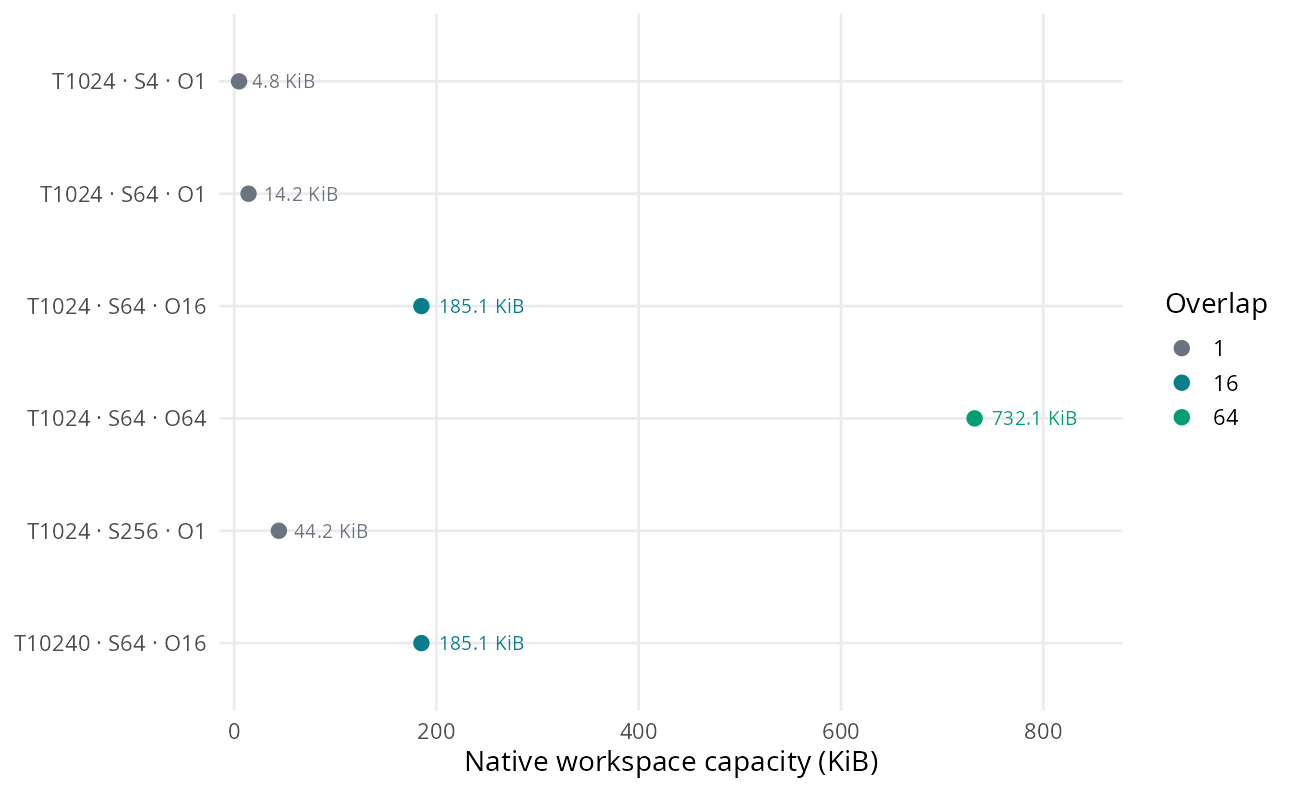
Per-workload native state observations
| transcripts | samples | overlap | peak_transcripts | peak_carriers | peak_prefixes | peak_events | peak_projections | peak_allele_bytes | workspace_bytes | model_bytes |
|---|---|---|---|---|---|---|---|---|---|---|
| 1024 | 4 | 1 | 1 | 7 | 6 | 4 | 4 | 10 | 4944 | 34136 |
| 1024 | 64 | 1 | 1 | 112 | 6 | 4 | 4 | 10 | 14544 | 34136 |
| 1024 | 64 | 16 | 16 | 1792 | 96 | 4 | 64 | 10 | 189564 | 34136 |
| 1024 | 64 | 64 | 64 | 7168 | 384 | 4 | 256 | 10 | 749628 | 34136 |
| 1024 | 256 | 1 | 1 | 448 | 6 | 4 | 4 | 10 | 45264 | 34136 |
| 10240 | 64 | 16 | 16 | 1792 | 96 | 4 | 64 | 10 | 189564 | 338264 |
Native workspace bytes count actual preallocated buffer capacities and
state, separately from immutable model allocations. The fixed fixture is
borrowed; validation additionally owns transcripts + 2 * samples bytes
outside the timed kernel workspace. Peak pool occupancy is measured by
the production stream. Increasing total transcripts at fixed cohort size
and overlap does not increase that workspace; immutable model storage
still grows with transcript count.
Both paths use the same active-pool limits. SQL additionally allows 65,536 alignment cells and 64 differing runs per axis, with a 64 MiB native workspace ceiling and a 4 GB DuckDB memory limit. SQL input, sorting and output memory belong to DuckDB and may grow with the complete relation. The process RSS table must not be presented as a constant-total-memory guarantee.
This same-input comparison retains three repeated passes per workload and revision. Neither compared campaign deliberately overlapped conformance work. Both ran at different times on a shared machine. CPU pinning does not isolate memory, thermal or scheduling effects, so timing differences do not establish the cost of the code change. One machine and this deliberately shared synthetic cohort do not establish production throughput, statistical significance or a general absence of regression. Whole-haplotype SO/HGVS and typed structural composition require their own measurements.
Reproduction
Run the R driver with a clean source-bound
extension receipt from the shared evidence builder; it stages inputs
through duckhtsbench. All six configurations above use
--passes 3 --cpu 2. To prepare the receipt from a clean checkout (no
network access in the build):
source("scripts/duckvep_evidence.R")
root <- normalizePath(".")
revision <- duckvep_evidence_revision(root)
extension <- duckvep_evidence_build_extension(root,
  "build/release/duckhts.duckdb_extension", revision)
duckvep_evidence_write_extension_receipt("/tmp/haplotype-extension.tsv", revision, extension)
Pass --extension-receipt /tmp/haplotype-extension.tsv to the R driver.
For a network-free smoke test without a clean-build certificate:
Rscript benchmarks/duckvep_haplotypes.R \
  --transcripts 16 --samples 4 --overlap 4 --passes 1 --diagnostic
Diagnostic results are retained but are not accepted into the recorded baseline.
Raw source-record SQL lane
--modes sql_records measures the public
input_mode := 'source_records' path under vep_compat; the default
--modes native,sql selects the decoded lanes reported above. All modes
use the same registered reference and four biallelic events. Source rows
carry the ordered ALT list and literal diploid GT text. The timed query
includes source validation, replay-order planning, raw-GT parsing,
allele expansion, sorting, replay and full nested output. File decoding
and model/input staging are outside timing. This is not a standalone raw
native kernel benchmark or a rare-configuration conformance campaign.
The source lane returns four paths per transcript and two carriers per
sample/transcript, including the occupied reference path. Decoded lanes
return three paths per transcript and 7/4 carriers per
sample/transcript. Complete CDS/protein strings, carrier multisets,
contributor IDs, ALT ordinals and block/edit counts are checked against
the fixture. Corruption controls cover changed CDS, protein, missing
CDS, carrier identity, missing ploidy, contributor identity, missing ALT
ordinal, invented HGVS, changed HGVS status, invalid source GT and
duplicate output. They run in the separate correctness worker. Contracts
with nominal_length_diff also reject a signed length change of +3
while all sequence flags remain untouched.
input_physical_records, input_record_sample_calls and
input_candidate_sample_rows are separately counted from the staged
source relation. REF, ALT and undefined-slot descriptors are execution
work, not extra physical records. For this biallelic workload the raw
lane reserves 13 active event slots, 12 * overlap + 1 projection slots
and 192 allele bytes; other limits match the decoded SQL lane.
Whole-process RSS includes both the decoded fixture table and the
derived source table. Output fingerprints include the raw lane’s
complete schema and reference paths; they are not substituted for
decoded-output fingerprints.
Rscript benchmarks/duckvep_haplotypes.R \
  --transcripts 16 --samples 4 --overlap 4 --passes 1 \
  --modes native,sql,sql_records --diagnostic
The source-bound raw lane uses three fresh-process passes at the current source, with one thread pinned to CPU 2. Its timing and process RSS appear in the timing table above; its input and output denominators are:
Source-record SQL input and output denominators
| transcripts | samples | overlap | input_physical_records | input_record_sample_calls | input_candidate_sample_rows | output_leaves | output_carriers |
|---|---|---|---|---|---|---|---|
| 1024 | 64 | 16 | 256 | 16384 | 262144 | 4096 | 131072 |
| output_leaves | cds_bytes | protein_bytes | json_bytes |
|---|---|---|---|
| 4096 | 737280 | 245760 | 14151208 |
The raw-lane comparison uses the same source revisions as the decoded comparison. Input hashes, complete output fingerprints, all listed denominators, thread count and output contract match between revisions. Different output denominators preclude treating raw versus decoded time as an implementation speedup.
Source-record SQL timing observations by revision
| transcripts | samples | overlap | median_s_before | median_s_after | median_change_percent | max_process_rss_mib_before | max_process_rss_mib_after |
|---|---|---|---|---|---|---|---|
| 1024 | 64 | 16 | 0.728 | 0.722 | -0.824 | 612.758 | 611.914 |
Singleton HGVS materialization
--modes sql_singletons,sql_singletons_hgvs compares the same decoded
input with protein HGVS disabled and enabled. Each sample carries one of
the four registered ALT events heterozygously. Four paths per transcript
retain all non-reference carriers; reference paths remain implicit. The
two substitutions and two frame-changing indels exercise the
independent-event HGVS consumer, not compound HGVS. This is a different
carrier distribution from the compound replay workload above; their
timings are not interchangeable.
The driver repeats the registered reference CDS at the model’s genomic coordinates, pads the inter-transcript sequence with A, and indexes that per-run FASTA. Both modes load exactly the same model and reference. A transcript has no UTR: explicitly empty pre-/post-CDS sequences distinguish a complete zero-length flank from an unavailable flank. Reference/model/input preparation is outside timing. The timed query includes sorting, bounded query initialization, sequence replay, differences, local coding facts and every output column. HGVS-enabled execution also opens its query-local faidx handle, retrieves genomic context and computes protein HGVS.
Each mode has a separate correctness process, followed by three fresh-process measurement passes with a full warm-up. Direct sequence replacement and Biostrings translation check every expected CDS/protein. Multiset comparisons check complete carrier identities, phase sets, ploidies and source-event membership. The enabled path also compares every event/transcript HGVSp with independent annotation, allowing only its documented prediction-parenthesis difference. That internal consistency check is not an independent VEP oracle or compound-HGVS certificate. The four fixed event shapes do not measure broad HGVS conformance.
Shared output corruptions and duplicate-output insertion must fail the correctness process. Nominal-length contracts also reject a same-frame +3 numeric corruption. HGVS-enabled checks additionally reject missing HGVS and malformed internal parentheses. Whole-output byte counts and fingerprints must match every pass of the same mode. All non-HGVS fields must match between modes. HGVS-on/off complete outputs intentionally differ and are never reported as identical work. The worker receipts retain the derived FASTA/index, actual versus independent HGVS, source/binary/input hashes, jobs and process logs. Process RSS includes setup, warm-up and post-query aggregates, not just native workspace.
Singleton HGVS timings, output denominators and revision comparison
Measured source: e3ec6d231cc7e5c769685761a4739c8fcffc30ff. One thread,
CPU 2, Intel i5-13500, DuckDB 1.5.3.
| transcripts | samples | overlap | mode | median_s | min_s | max_s | peak_process_rss_mib |
|---|---|---|---|---|---|---|---|
| 1024 | 64 | 16 | sql_singletons | 0.339 | 0.336 | 0.342 | 410.0391 |
| 10240 | 64 | 16 | sql_singletons | 4.107 | 4.107 | 4.110 | 2190.9570 |
| 1024 | 64 | 16 | sql_singletons_hgvs | 0.348 | 0.346 | 0.348 | 409.0586 |
| 10240 | 64 | 16 | sql_singletons_hgvs | 4.179 | 4.170 | 4.187 | 2191.1094 |
| transcripts | samples | overlap | mode | input_physical_records | input_record_sample_calls | input_candidate_sample_rows | output_leaves | output_carriers | cds_bytes | protein_bytes | json_bytes |
|---|---|---|---|---|---|---|---|---|---|---|---|
| 1024 | 64 | 16 | sql_singletons | 256 | 16384 | 262144 | 4096 | 65536 | 737280 | 244736 | 9006696 |
| 1024 | 64 | 16 | sql_singletons_hgvs | 256 | 16384 | 262144 | 4096 | 65536 | 737280 | 244736 | 9014888 |
| 10240 | 64 | 16 | sql_singletons | 2560 | 163840 | 2621440 | 40960 | 655360 | 7372800 | 2447360 | 90229832 |
| 10240 | 64 | 16 | sql_singletons_hgvs | 2560 | 163840 | 2621440 | 40960 | 655360 | 7372800 | 2447360 | 90311752 |
Nearest same-input source: 84770198dd9e43ddd4aa936d2f5bf9c3deabe550.
Full-output fingerprints, input identities and every listed denominator
match within each mode.
| transcripts | samples | overlap | mode | median_s_before | min_s_before | max_s_before | peak_process_rss_mib_before | median_s_after | min_s_after | max_s_after | peak_process_rss_mib_after | median_change_percent |
|---|---|---|---|---|---|---|---|---|---|---|---|---|
| 1024 | 64 | 16 | sql_singletons | 0.341 | 0.339 | 0.343 | 409.0000 | 0.339 | 0.336 | 0.342 | 410.0391 | -0.5865 |
| 1024 | 64 | 16 | sql_singletons_hgvs | 0.349 | 0.343 | 0.359 | 409.6328 | 0.348 | 0.346 | 0.348 | 409.0586 | -0.2865 |
| 10240 | 64 | 16 | sql_singletons | 4.136 | 4.123 | 4.151 | 2191.0039 | 4.107 | 4.107 | 4.110 | 2190.9570 | -0.7012 |
| 10240 | 64 | 16 | sql_singletons_hgvs | 4.210 | 4.208 | 4.340 | 2191.3047 | 4.179 | 4.170 | 4.187 | 2191.1094 | -0.7363 |
Singleton HGVS borrows the decoded stream’s successful physical CDS projection. VEP’s uploaded-feature interpretation and shifted-HGVS placement remain distinct; raw-source HGVS prepares and projects its own minimized allele. Leaf and contributor storage is included in the query workspace limit. These whole-process measurements do not isolate that storage cost or the projection cost. Three passes on one machine do not establish statistical significance or a general absence of regression. Compound HGVS, raw-input omissions, multi-exon models and heterogeneous genomic contexts still need their own matched measurements. The compound replay and raw-record baselines above retain their original source revisions and denominators.
Rscript benchmarks/duckvep_haplotypes.R \
  --transcripts 16 --samples 4 --overlap 4 --passes 1 \
  --modes sql_singletons,sql_singletons_hgvs --diagnostic