Throughput depends on the output you request and the rows each allele produces. The charts separate pinned resident annotation from dense-region threading and whole-genome composition. Methods, measurement scope and reproduction cover the details; CSV receipts retain every recorded run.
Public relation API cost and scaling
The same HG002 relation emits 47,835,851 rows at either worker count. Compact, rich, HGVS and fused rich+HGVS each pass their cross-thread output checks.
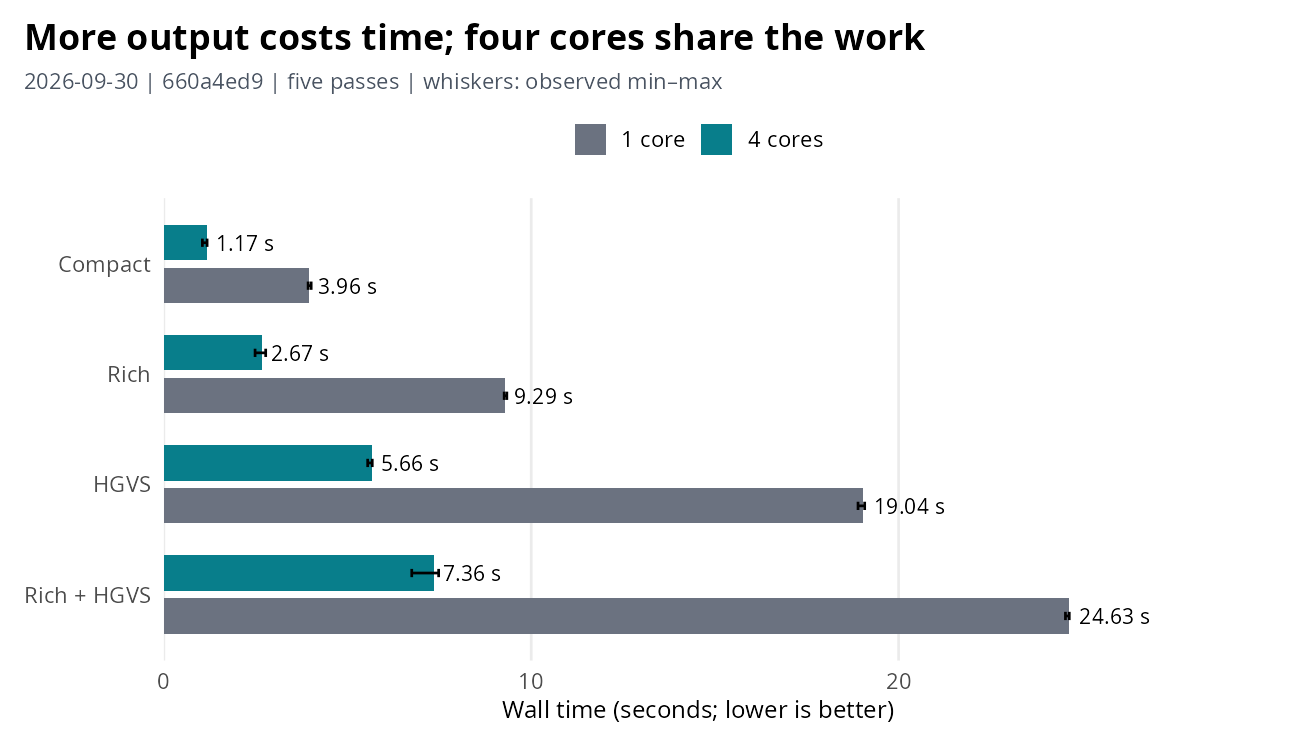
The public relation dispatcher distributes ordered input across workers. One core is pinned to CPU 2; four cores to 2,4,6,8. The receipt records CPU-set contention.
Full-corpus core VEP model
These one-core measurements use the complete Ensembl 116 GRCh38 transcript, regulatory and motif model. Timers include result production and aggregation; loading and file ingestion are outside the measurement.
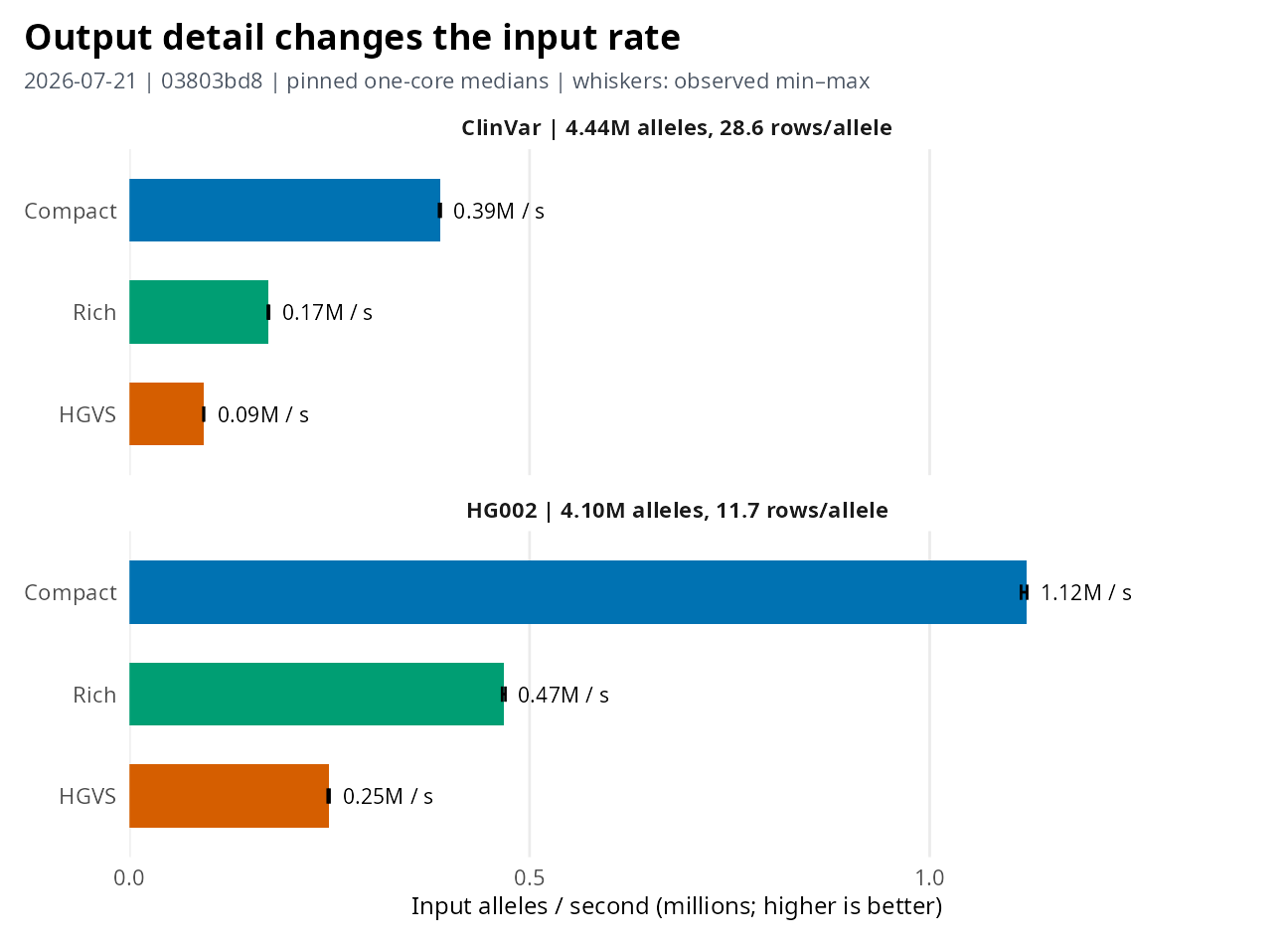
Rows per allele differ between corpora. An input rate alone does not describe the amount of output produced.
Dense-region threading and halo
This fixture has 517,097 ClinVar alleles in 318 annotation-dense tiles. Each halo pairs one core with four ordered partitions; matching fingerprints verify the same output rows.
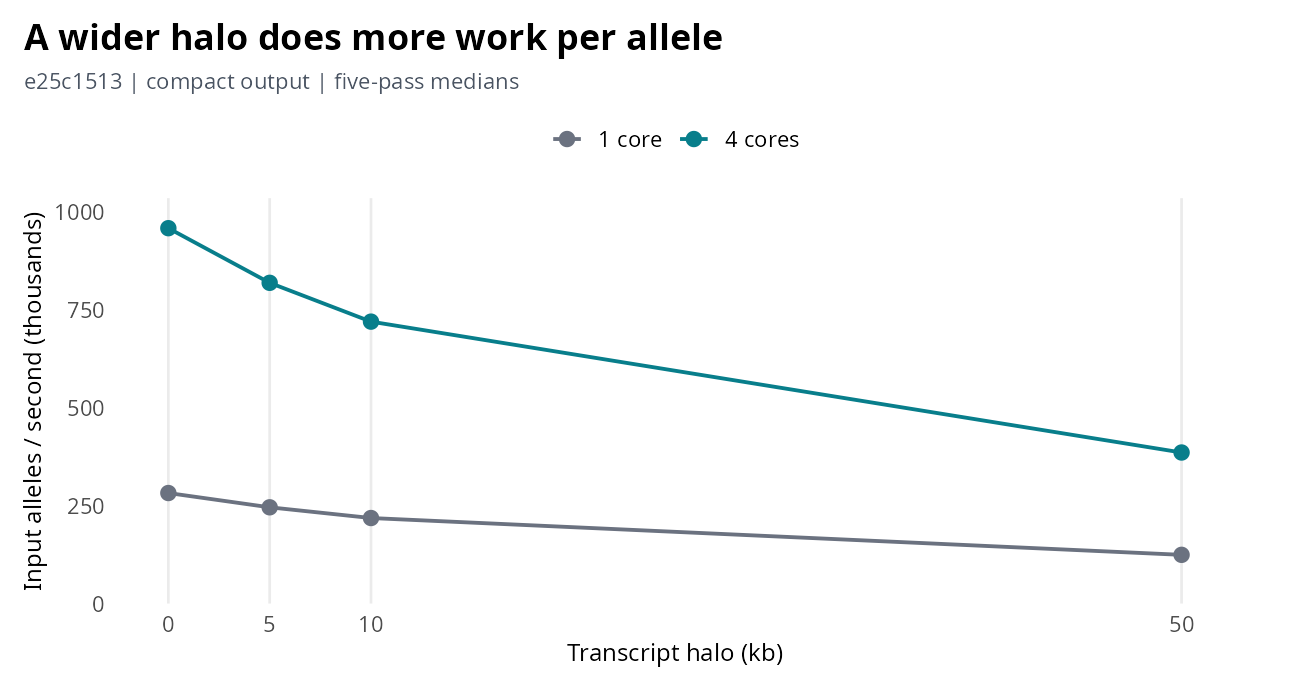
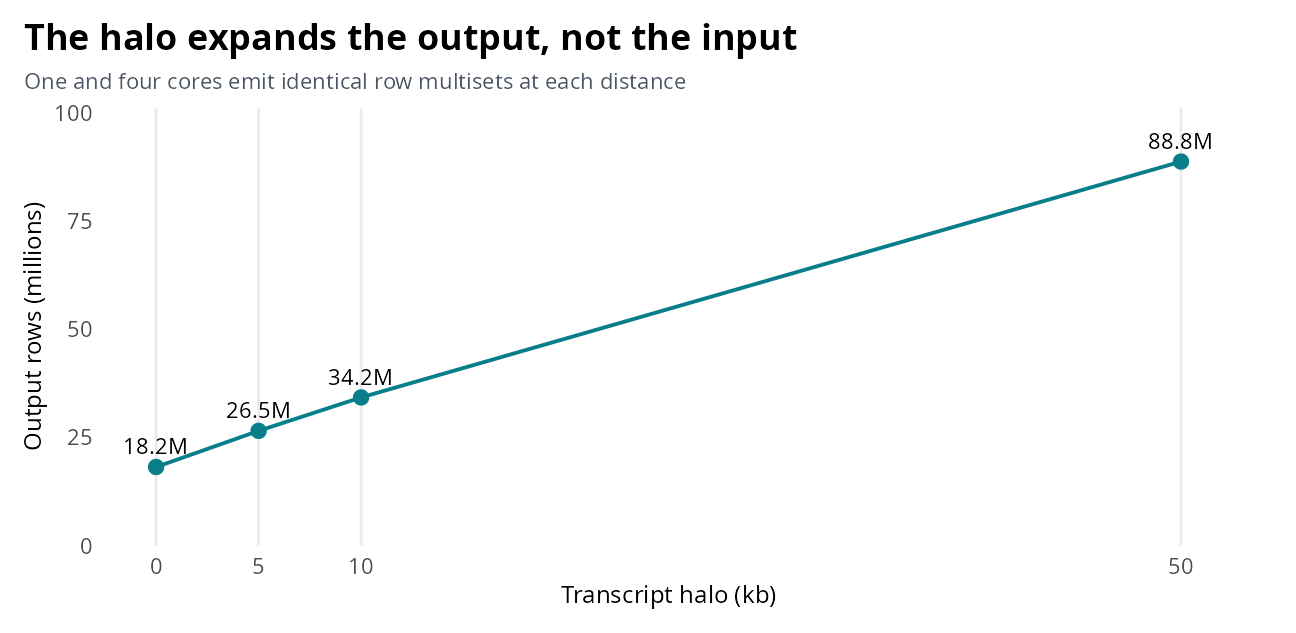
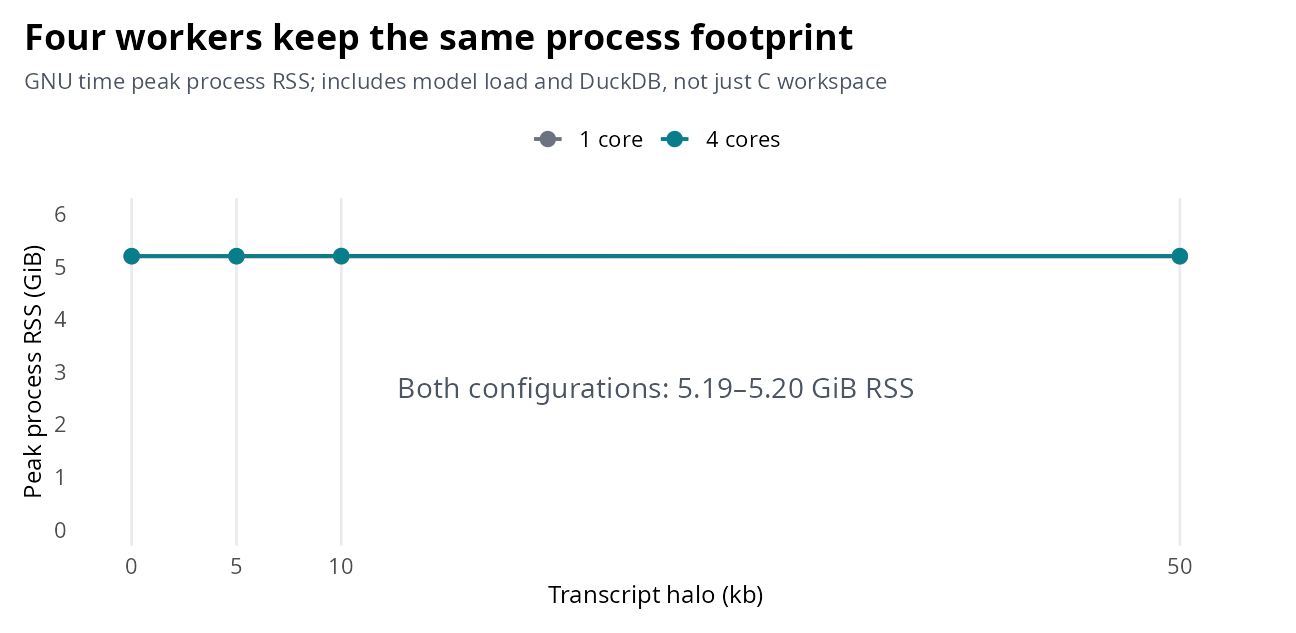
Measurements cover these halos and four partitions on the annotation-dense panel. RSS differences are process measurements, not allocation attribution.
Real whole-genome composition run
A separate DeepVariant HG002 WGS run writes complete rich+HGVS output joined to ClinVar, ClinvArbitration, AlphaMissense, gene constraint and Ensembl regulation. It uses four writers, warm page cache and no CPU pinning.
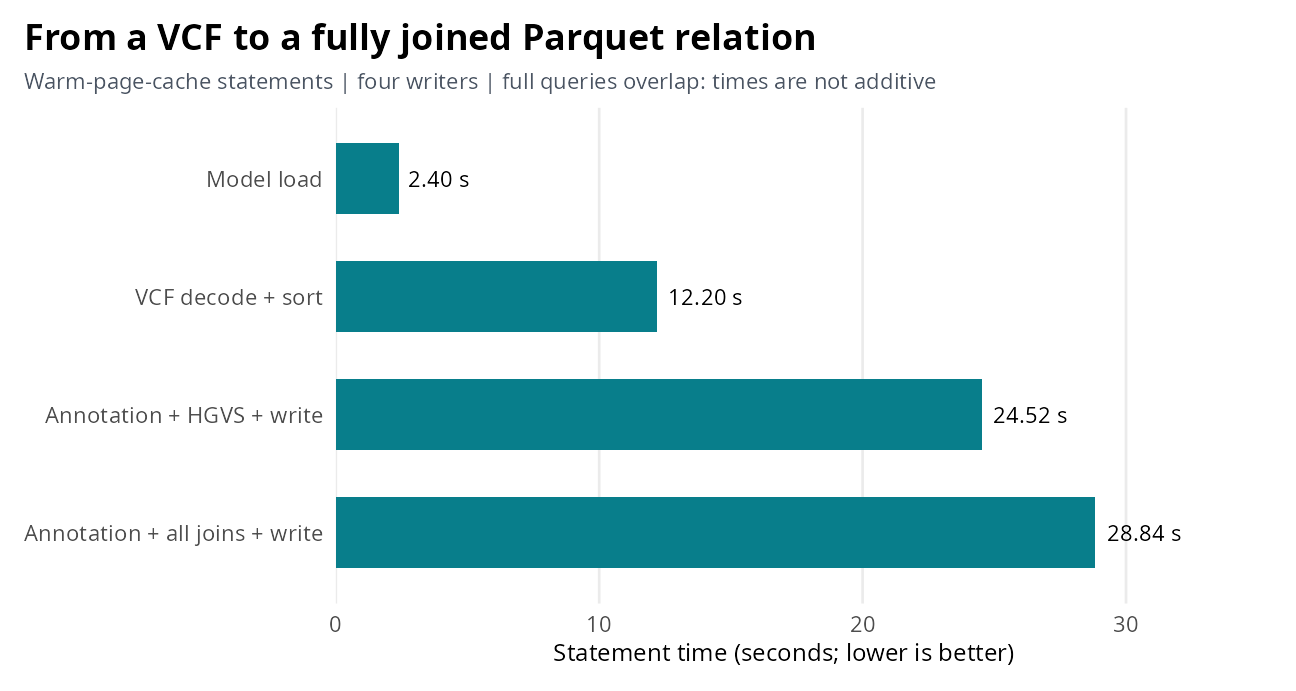
The all-provider query writes 88,392,840 rows in 28.84 seconds, with 5.31 GiB peak RSS. These are integration measurements, separate from the pinned resident rates.
Interval join plans
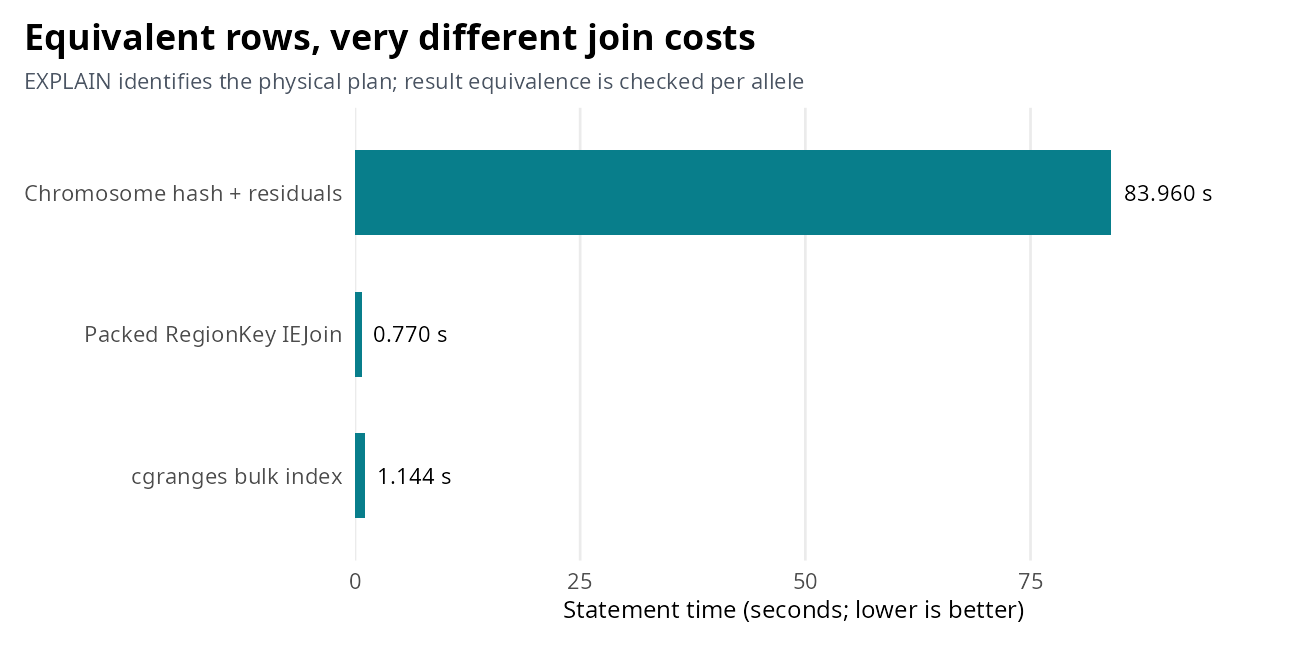
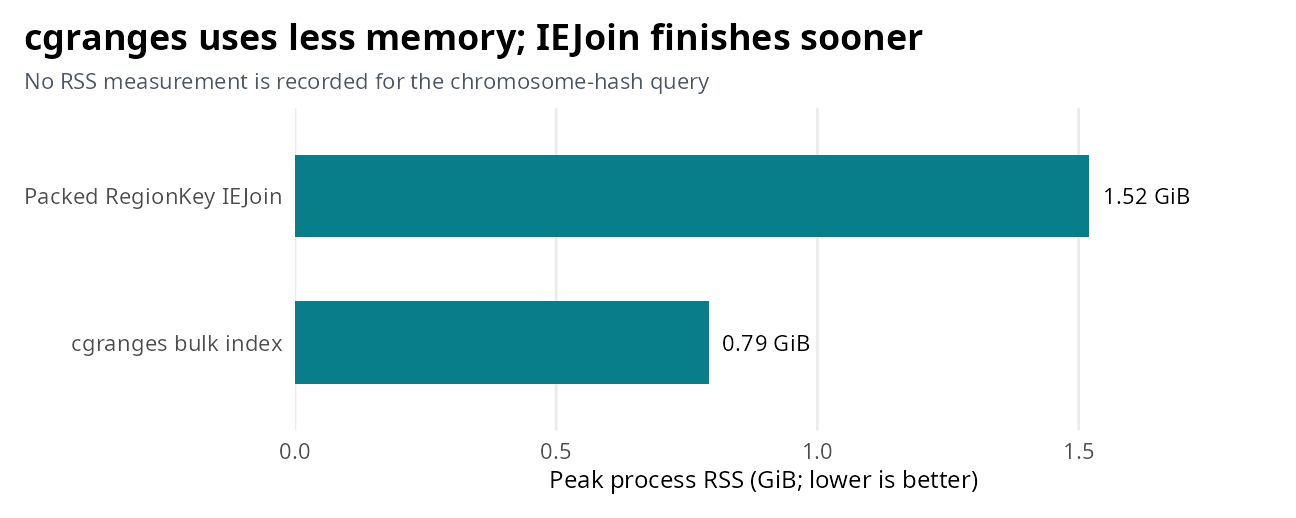
All three implementations return the same 745,252 overlap pairs and match the same 414,813 alleles. The physical join plan controls the work.
Evidence and reproduction
Methods and scope define the timers, output surfaces and equality checks. CSVs retain full provenance and raw measurements: resident annotation, dense threading, whole-genome statements, and interval equivalence.
Render the plots and this report from the repository root:
Rscript benchmarks/scripts/render_benchmarks.R throughput