DuckHTS reads standard BAM; DuckDB prepares alignment, junction and evidence-family tables. Region and junction macros query that serving cache without reparsing CIGAR. Each row keeps the BGZF offset of its source record, so read names, CIGARs and raw tags stay in the BAM and remain reachable.
This product reproduces useful AIE capabilities with an explicit counting contract, rather than inheriting every Gravlax policy. Annotation replay remains the demo’s separately scoped compatibility surface; it is not yet an independently validated product surface.
Count meanings
- UMI labels: exact selected UMI strings per cell and query. They are not physical-molecule estimates; a reused UMI in another locus remains one label.
- Evidence families: exact cell/UMI/contig/strand keys with transitively overlapping primary reference spans. No arbitrary 50 kb gap or implicit sequence-error absorption. These are inspectable evidence groups, not proof of one biological molecule each.
- Gravlax: its corrected barcode assignments and UMI-class abstraction.
The default trusts supplied CB and retains raw UR for annotation-ready evidence. An explicit UB cache selects supplied corrected tags. Missing tags are audited, not silently substituted. See the counting contract.
Different count meanings prevent an equal-output speedup claim. The graphs compare costs of the declared products and preserve their returned counts.
Actual PBMC input
Source: public 10x Cell Ranger 3.0.0 pbmc_1k_v3, a 4.79 GB BAM
with GRCh38 contig names. The complete source was acquired over HTTPS
with its observed ETag fixed, size checked, samtools quickcheck
verified and SHA-256 recorded.
One source pass produces nested 1M / 2M / 4M genuine primary records—no read or barcode replication. These inputs retain mapped, nonsupplementary NH=1 records with all CB/UB/CR/UR tags present. They are restricted real-cohort prefixes, not the entire cohort and not general multimapper performance. Source and derived BAMs use an owned tmpfs cache; prepared states use the local filesystem. The protocol declares these choices and budgets before acquisition and measurement.
Preparation
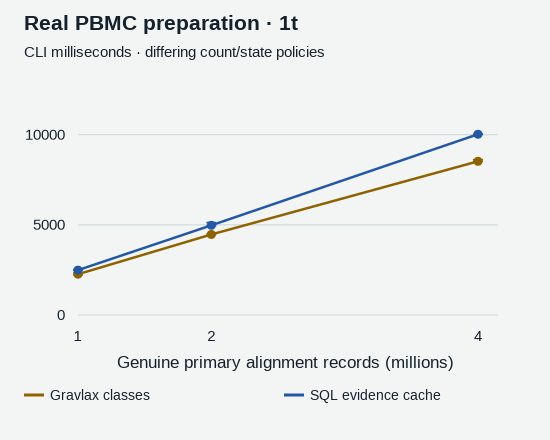
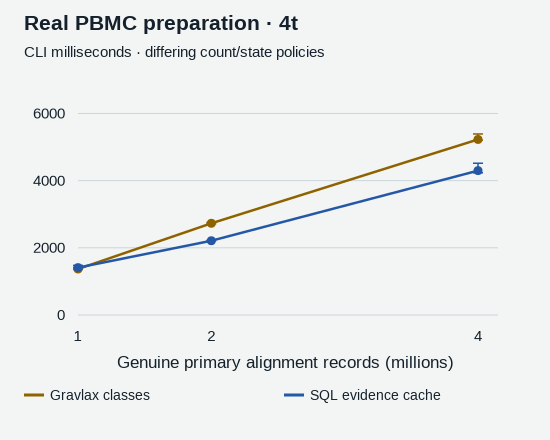
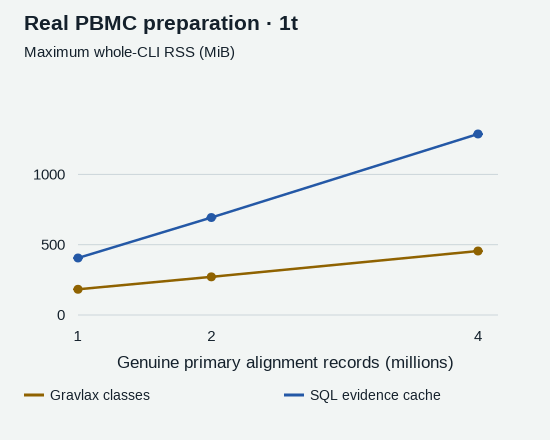
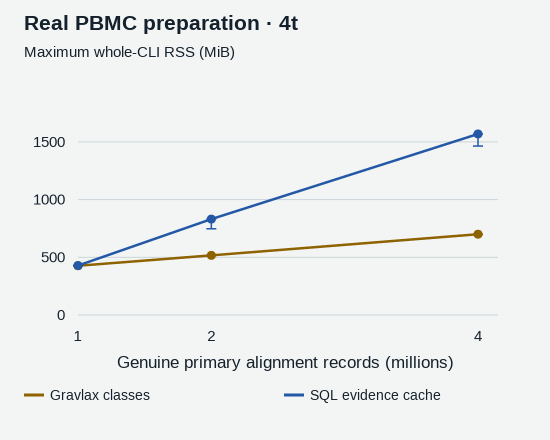
Preparation includes CLI startup, BAM parsing, policy processing and persisting state. The SQL cache retains one row per source record, a pointer to it and two explicit count surfaces; Gravlax retains its dedicated molecular archive. Prepared bytes are reported below, not treated as representation parity.
What the rewrite changed
| Records | Threads | Previous SQL s | Current SQL s | Gravlax s | Previous MiB | Current MiB | Gravlax MiB |
|---|---|---|---|---|---|---|---|
| 1e+06 | 1 | 6.21 | 2.49 | 2.26 | 69.3 | 36.5 | 1.8 |
| 2e+06 | 1 | 12.39 | 4.98 | 4.47 | 137.8 | 72.0 | 3.7 |
| 4e+06 | 1 | 24.80 | 10.03 | 8.53 | 269.5 | 140.3 | 6.9 |
| 1e+06 | 4 | 3.92 | 1.41 | 1.37 | 77.5 | 36.8 | 1.8 |
| 2e+06 | 4 | 6.86 | 2.21 | 2.73 | 150.8 | 72.8 | 3.7 |
| 4e+06 | 4 | 13.86 | 4.30 | 5.23 | 301.5 | 144.0 | 6.9 |
Both SQL columns ran on the same extension, CLI and host, so this
difference comes from the SQL. The same 4M, four-thread profile of the
previous SQL spent 8.2 of 13.7 seconds in one statement that built the
tag map and wrote observations; the CIGAR regex took about 0.3
seconds. A scan of the same 4M records takes 0.52 seconds with named
tags and 2.04 seconds through the tag map. The rewrite:
- reads
URandUBas named columns instead of building a map for each record; - uses
FILE_OFFSETas the alignment id, which removes arow_number()window; - stops copying read names, CIGARs and raw tags, which stay in the BAM;
- derives spans with
cigar_reference_lengthand tokenizes only spliced CIGARs; - names each family by its first alignment, which removes a global
dense_rank; - preserves insertion order only for the tables that rely on sort order.
Every table, view and retained column matches the previous SQL on the
real 4M input, apart from ids, and all 72 SQL query results in the two
runs have the same cell and count totals. The cost is that raw tags are
no longer queryable in bulk from the cache:
aie_source_record(bam, alignment_id) returns one record by scanning
the BAM, which took 5.7 seconds on the 4M input in a single run.
Without a .bai, four-thread 4M preparation takes 4.49 seconds.
Full-chromosome query
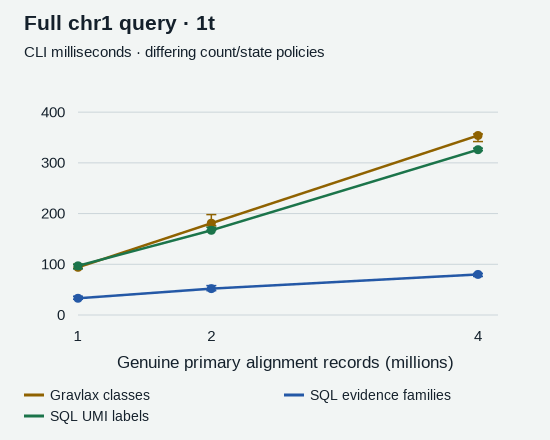
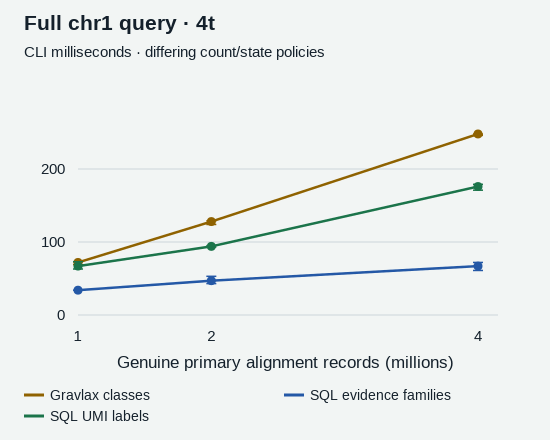
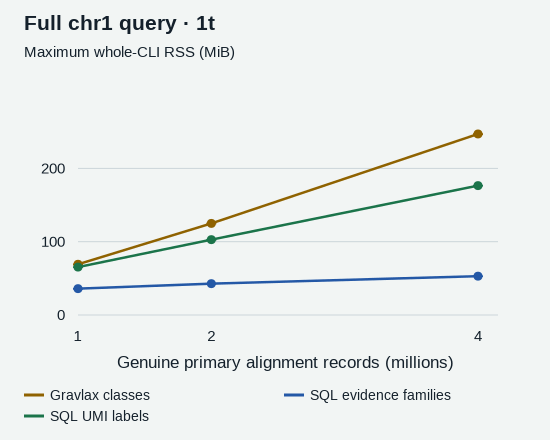
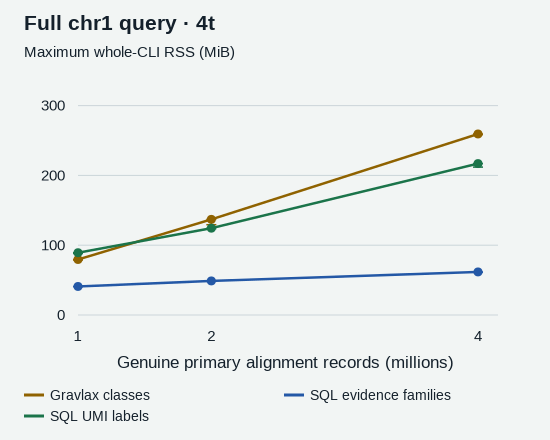
The fixed-window query is 1:1-3000000; the full query is
1:1-248956422. Three fresh processes per point include startup, state
opening, evaluation and writing every cell count. There are no
five-second padding loops. Short query latencies are CLI diagnostics,
not a STYLE timing verdict. Whiskers are the three-run range, not
confidence intervals.
Validation and biological differences
The product passes an independent scalar CIGAR cursor and pairwise interval-graph oracle under both tag policies. Tests cover later introns, D versus N, strand and contig separation, transitive overlaps, GEM-group identity, missing tags and primary filtering and variable-length leading-A UMI labels. Real raw-label counts on the 4M-record input’s full-chr1 and 3 Mb queries also match independent samtools/awk. Five semantic mutants—skip cursor, reference span, 50 kb merging, strand loss and secondary inclusion—disagree with that oracle; restored SQL passes. Source-record pointers are checked against every fixture record.
The real 109,271-record pilot has 653 cell-count differences when using supplied CB/UB. Selecting CB/raw UR reduces disagreement with Gravlax to one cell (28 versus 29). That cell has three raw barcode variants in the input. This narrows the remaining investigation; it does not justify relabelling the entire discrepancy as intentional or demanding blind upstream emulation.
The raw real-comparison rows include output cell counts and count sums for every query. Returned counts must remain visible alongside performance.
Exact data and limitations
| Engine | Operation | Records | Threads | Status | CLI ms: median [min, max] | Max RSS MiB | Prepared MiB | Output cells | Count sum |
|---|---|---|---|---|---|---|---|---|---|
| gravlax | prepare | 1e+06 | 1 | PASS | 2264.0 [2227.0, 2334.0] | 182.9 | 1.8 | ||
| sql | prepare | 1e+06 | 1 | PASS | 2491.0 [2490.0, 2520.0] | 405.5 | 36.5 | ||
| gravlax | region-full | 1e+06 | 1 | PASS | 94.0 [92.0, 100.0] | 69.2 | NA | 23170 | 322755 |
| sql | region-full-families | 1e+06 | 1 | PASS | 33.0 [31.0, 37.0] | 36.0 | NA | 23171 | 373870 |
| sql | region-full-labels | 1e+06 | 1 | PASS | 97.0 [91.0, 100.0] | 65.4 | NA | 23171 | 322759 |
| gravlax | region-window | 1e+06 | 1 | PASS | 21.0 [20.0, 22.0] | 19.2 | NA | 4614 | 42974 |
| sql | region-window-families | 1e+06 | 1 | PASS | 24.0 [22.0, 25.0] | 31.2 | NA | 4615 | 47616 |
| sql | region-window-labels | 1e+06 | 1 | PASS | 28.0 [28.0, 32.0] | 36.4 | NA | 4615 | 42975 |
| gravlax | prepare | 2e+06 | 1 | PASS | 4469.0 [4459.0, 4491.0] | 271.4 | 3.7 | ||
| sql | prepare | 2e+06 | 1 | PASS | 4976.0 [4953.0, 5130.0] | 693.3 | 72.0 | ||
| gravlax | region-full | 2e+06 | 1 | PASS | 181.0 [176.0, 198.0] | 124.9 | NA | 41958 | 641307 |
| sql | region-full-families | 2e+06 | 1 | PASS | 52.0 [48.0, 58.0] | 42.8 | NA | 41959 | 744884 |
| sql | region-full-labels | 2e+06 | 1 | PASS | 167.0 [167.0, 173.0] | 102.8 | NA | 41959 | 641317 |
| gravlax | region-window | 2e+06 | 1 | PASS | 22.0 [18.0, 22.0] | 19.4 | NA | 4614 | 42974 |
| sql | region-window-families | 2e+06 | 1 | PASS | 26.0 [17.0, 26.0] | 31.6 | NA | 4615 | 47616 |
| sql | region-window-labels | 2e+06 | 1 | PASS | 29.0 [28.0, 36.0] | 36.3 | NA | 4615 | 42975 |
| gravlax | prepare | 4e+06 | 1 | PASS | 8526.0 [8520.0, 8617.0] | 455.1 | 6.9 | ||
| sql | prepare | 4e+06 | 1 | PASS | 10028.0 [10019.0, 10043.0] | 1287.6 | 140.3 | ||
| gravlax | region-full | 4e+06 | 1 | PASS | 354.0 [342.0, 357.0] | 247.0 | NA | 70260 | 1301501 |
| sql | region-full-families | 4e+06 | 1 | PASS | 80.0 [76.0, 82.0] | 53.0 | NA | 70262 | 1522290 |
| sql | region-full-labels | 4e+06 | 1 | PASS | 326.0 [324.0, 329.0] | 176.5 | NA | 70262 | 1301527 |
| gravlax | region-window | 4e+06 | 1 | PASS | 22.0 [22.0, 23.0] | 19.5 | NA | 4614 | 42974 |
| sql | region-window-families | 4e+06 | 1 | PASS | 23.0 [20.0, 23.0] | 31.7 | NA | 4615 | 47616 |
| sql | region-window-labels | 4e+06 | 1 | PASS | 29.0 [24.0, 31.0] | 36.7 | NA | 4615 | 42975 |
| gravlax | prepare | 1e+06 | 4 | PASS | 1369.0 [1354.0, 1413.0] | 426.8 | 1.8 | ||
| sql | prepare | 1e+06 | 4 | PASS | 1411.0 [1401.0, 1477.0] | 428.6 | 36.8 | ||
| gravlax | region-full | 1e+06 | 4 | PASS | 72.0 [69.0, 73.0] | 79.5 | NA | 23170 | 322755 |
| sql | region-full-families | 1e+06 | 4 | PASS | 34.0 [34.0, 34.0] | 40.9 | NA | 23171 | 373870 |
| sql | region-full-labels | 1e+06 | 4 | PASS | 67.0 [63.0, 73.0] | 89.2 | NA | 23171 | 322759 |
| gravlax | region-window | 1e+06 | 4 | PASS | 16.0 [14.0, 23.0] | 19.2 | NA | 4614 | 42974 |
| sql | region-window-families | 1e+06 | 4 | PASS | 23.0 [19.0, 25.0] | 33.1 | NA | 4615 | 47616 |
| sql | region-window-labels | 1e+06 | 4 | PASS | 33.0 [27.0, 34.0] | 41.9 | NA | 4615 | 42975 |
| gravlax | prepare | 2e+06 | 4 | PASS | 2730.0 [2717.0, 2755.0] | 516.8 | 3.7 | ||
| sql | prepare | 2e+06 | 4 | PASS | 2211.0 [2209.0, 2222.0] | 831.1 | 72.8 | ||
| gravlax | region-full | 2e+06 | 4 | PASS | 128.0 [124.0, 129.0] | 137.0 | NA | 41958 | 641307 |
| sql | region-full-families | 2e+06 | 4 | PASS | 47.0 [43.0, 53.0] | 48.8 | NA | 41959 | 744884 |
| sql | region-full-labels | 2e+06 | 4 | PASS | 94.0 [93.0, 95.0] | 124.4 | NA | 41959 | 641317 |
| gravlax | region-window | 2e+06 | 4 | PASS | 19.0 [18.0, 20.0] | 18.9 | NA | 4614 | 42974 |
| sql | region-window-families | 2e+06 | 4 | PASS | 23.0 [22.0, 25.0] | 33.6 | NA | 4615 | 47616 |
| sql | region-window-labels | 2e+06 | 4 | PASS | 30.0 [28.0, 32.0] | 41.9 | NA | 4615 | 42975 |
| gravlax | prepare | 4e+06 | 4 | PASS | 5226.0 [5203.0, 5389.0] | 700.0 | 6.9 | ||
| sql | prepare | 4e+06 | 4 | PASS | 4298.0 [4232.0, 4518.0] | 1568.7 | 144.0 | ||
| gravlax | region-full | 4e+06 | 4 | PASS | 248.0 [246.0, 248.0] | 259.4 | NA | 70260 | 1301501 |
| sql | region-full-families | 4e+06 | 4 | PASS | 67.0 [61.0, 72.0] | 61.7 | NA | 70262 | 1522290 |
| sql | region-full-labels | 4e+06 | 4 | PASS | 176.0 [171.0, 179.0] | 216.9 | NA | 70262 | 1301527 |
| gravlax | region-window | 4e+06 | 4 | PASS | 22.0 [22.0, 22.0] | 19.8 | NA | 4614 | 42974 |
| sql | region-window-families | 4e+06 | 4 | PASS | 23.0 [22.0, 28.0] | 33.4 | NA | 4615 | 47616 |
| sql | region-window-labels | 4e+06 | 4 | PASS | 34.0 [30.0, 34.0] | 42.0 | NA | 4615 | 42975 |
Raw rows, source snapshots and input/runtime hashes for this run and the earlier run with its acquisition receipts are preserved. Each process has a 180-second wall ceiling and 4 GiB RSS ceiling; DuckDB uses 2 GiB buffer and 2 GiB spill limits. Prepared state is capped at 4 GiB. Failures remain in the table; no retry replaces them.
This is real-input evidence, not full product completion. Whole-cohort annotation performance, a general multimapper workload and full STYLE qualification remain unverified. The purpose-built original still wins one-thread preparation, peak memory and archive size, by about 20 times on size. Its fixed-window query is level with SQL families and faster than SQL labels at one thread.
Reproduce
cd demos/aie
./check_evidence.sh
./derive_real.sh /path/to/pbmc_1k_v3.bam /new/ladder
Rscript --vanilla measure_real.R /new/ladder work/new-real-comparison
# One reusable product cache, with explicit tag policy:
./prepare_evidence.sh /path/to/input.bam work/input.duckdb sample UR 4
duckdb work/input.duckdb -c "SELECT * FROM aie_region_families('1',1,3000000);"
DUCKDB and DUCKHTS_EXTENSION select recorded runtime artifacts. Use
new output directories; preserve previous receipts. Render this report
from committed evidence, not by rerunning engines. From the repository
root, Rscript scripts/plot-benchmarks.R regenerates the static SVGs.